Platform Architecture
AECloud separates profile administration, merchant operations, customer requests, downstream integration, and LHDN processing. This separation helps each user or connected system work only within its intended role.
AECloud operates between the merchant's business systems and MyInvois as an authorized intermediary. It is not LHDN, and the AECloud Integration API is not the MyInvois API under another name.
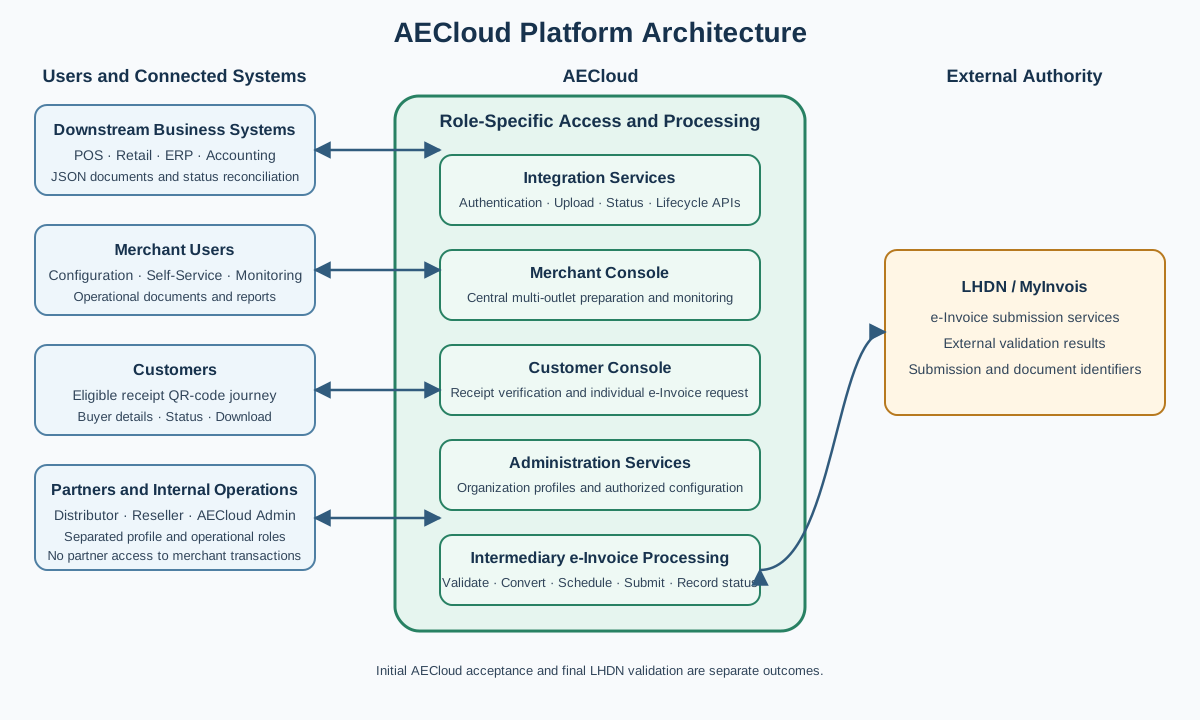
Main components
Downstream business systems
A merchant-controlled POS, retail, ERP, accounting, or other approved system can send supported business documents to the AECloud Integration API. The connected system is responsible for accurate source data, stable business identifiers, secure credential storage, duplicate prevention, and final-status reconciliation.
The current integration supports sale invoices, credit notes, debit notes, refund notes, and the corresponding four self-billed document families.
Partner administration consoles
The Distributor and Reseller Consoles support organization and customer-profile administration.
- A distributor may serve an appointed state, territory, or business region. It manages its own profile, its appointed resellers, and approved OAuth2 credentials for itself or resellers under its management.
- A reseller registers and maintains its appointed merchants and approved merchant configuration.
- Distributor and reseller users are not permitted to view merchant sales transaction records.
- Distributor users do not manage merchant outlets.
These consoles are not document-submission or transaction-monitoring workspaces.
Merchant Console
The Merchant Console is the merchant's centralized operational workspace. It provides merchant and outlet configuration, LHDN-related configuration, master data, Self-Service document preparation, operational submission lists, status review, e-Invoice records, and reports according to the user's authorized access. Authorized merchant users can review activity received from their connected outlets in one place, normally close to the time AECloud receives and processes it.
Near-real-time visibility describes the availability of data in AECloud. It does not mean that MyInvois has already completed validation.
Two areas must remain distinct:
- Self-Service is used to prepare a document manually or by supported bulk import.
- LHDN Submission is used to monitor documents that have entered the operational submission path, whether they originated in Self-Service or an integrated downstream system.
Customer Console
The Customer Console opens from the QR code associated with an eligible merchant receipt. Here, customer means the buyer named on, or requesting, the merchant's e-Invoice. It is distinct from a merchant organization and from a customer record maintained in the Merchant Console's master data.
The customer does not need a normal console username and password. Access remains tied to the receipt link and its eligibility.
AECloud processing services
AECloud authenticates approved connections, resolves the merchant and outlet, performs initial structural and business checks, stores the document, prepares the applicable e-Invoice representation, starts or schedules processing, records identifiers and responses, and exposes status or permitted lifecycle operations.
Initial acceptance by AECloud and final validation by LHDN are separate stages. A document can be stored successfully while still awaiting scheduled processing or a later validation result.
LHDN/MyInvois
AECloud communicates with LHDN Malaysia's MyInvois services for the applicable external e-Invoice operations. With the taxpayer's required intermediary permission, AECloud authenticates separately to MyInvois and acts on behalf of that taxpayer. MyInvois returns submission and document information and ultimately determines whether a submitted document is valid or invalid under its processing rules.
Integrators call the AECloud contract documented in the API Integration Developer Guide, not the MyInvois document-submission contract directly through AECloud endpoints.
Responsibility boundaries
| Responsibility | Primary owner |
|---|---|
| Source transaction accuracy | Merchant and source business system |
| Customer or supplier identity accuracy | Merchant, customer, and source system as applicable |
| Merchant, outlet, and submission configuration | Authorized merchant, reseller, or AECloud personnel according to role |
| API credential protection | Credential owner and integration operator |
| Initial request validation and storage | AECloud |
| Conversion and submission orchestration | AECloud |
| Technical alignment of the AECloud-to-MyInvois integration | AECloud |
| External e-Invoice validation result | LHDN/MyInvois |
| Status monitoring and business reconciliation | Merchant and integration operator |
| Corrections at the source | Owner of the original source data |
Security boundaries
- Console access is role-based and must not be shared.
- API credentials are system credentials and must not be placed in source code, screenshots, email, or public documentation.
- Receipt links, long IDs, exported files, payloads, and responses can expose confidential business or personal information.
- Public diagrams should use generic labels only; operational screenshots should not be published unless all confidential data has been removed and the result has been separately approved.